How Does NeuroStar TMS Work?
NeuroStar® TMS (Transcranial Magnetic Stimulation) works by delivering focused, MRI-strength magnetic pulses to stimulate underactive nerve cells in the left dorsolateral prefrontal cortex (DLPFC)—the mood-regulating center of the brain. These targeted pulses awaken dormant neural circuits, stimulate the natural release of neurotransmitters (serotonin, dopamine, and norepinephrine), and promote neuroplasticity. Unlike oral antidepressants, NeuroStar TMS is non-systemic, non-invasive, and requires zero anesthesia, sedation, or downtime.
When first-line antidepressant medications cause difficult side effects—or fail to provide relief—patients are often left searching for answers. If you are exploring non-drug treatments for depression, understanding how does NeuroStar TMS work can empower you to make informed decisions about your mental healthcare.
At Tranquil Minds Mental Health in Monticello, Minnesota, we provide NeuroStar® Advanced Therapy. As an FDA-cleared psychiatric medical technology, NeuroStar TMS treats Major Depressive Disorder, anxious depression, adolescent depression, and OCD directly at the neurological source.
In this guide, we break down the physics and biology of magnetic stimulation, provide a clear walkthrough of a treatment session, contrast TMS with oral antidepressants, and review what to expect during care.
In This Clinical Guide:
- → Depression and the Underactive Brain
- → The Science of Magnetic Pulses & Induction
- → Neuroplasticity: Rewiring Neural Pathways
- → Step-by-Step: Inside a Treatment Session
- → Treatment Protocol & Results Timeline
- → NeuroStar TMS vs. Medications & ECT
- → Proven Clinical Benefits & Real-World Outcomes
- → Who Qualifies for NeuroStar TMS?
- → Comprehensive Care & Clinical Support
- → Conclusion: Reclaiming Mental Wellness
- → Frequently Asked Questions (FAQs)
Depression and the Underactive Brain: The Neurological Root
Clinical depression is a biological condition involving disruptions in electrical signaling, structural connectivity, and blood flow in specific regions of the brain.
Functional neuroimaging studies consistently demonstrate that individuals with depression experience hypometabolism (underactivity) in the left dorsolateral prefrontal cortex (DLPFC). This region oversees critical cognitive and emotional functions:
- Mood regulation: Modulating emotional responses to stress and sadness.
- Executive functioning: Mental focus, decision-making, and motivation.
- Inhibiting negative rumination: Dampening intrusive feelings of guilt or hopelessness.
When the left DLPFC becomes underactive, communication with deeper emotional centers—such as the amygdala and hippocampus—slows down. Rather than flooding the entire body with synthetic drugs, NeuroStar TMS directly stimulates this dormant region using focused magnetic energy. Learn more on our What Is TMS Therapy page.
The Physics & Neuroscience: How Magnetic Pulses Awaken Neurons
The core principle behind TMS is electromagnetic induction, first discovered by Michael Faraday. For an authoritative clinical overview of the science, explore Transcranial Magnetic Stimulation on Wikipedia.
NeuroStar Advanced Therapy applies this principle through a precise three-step mechanism:
Magnetic Pulse Generation
The NeuroStar coil produces brief, pulsed magnetic fields equivalent in strength to an MRI machine (approx. 1.5 to 2.0 Tesla).
Painless Penetration
Magnetic fields pass painlessly through the scalp and skull without resistance, reaching 2–3 centimeters into the cortical tissue.
Micro-Current Activation
Magnetic energy induces tiny micro-currents that depolarize cortical neurons, stimulating natural releases of serotonin, dopamine, and norepinephrine.
By activating these neurons, TMS prompts the brain to produce and circulate its own neurochemicals naturally. Read our in-depth safety review: Is NeuroStar TMS Therapy Safe?.
Neuroplasticity: How Repeated TMS Sessions Rewire the Brain
While individual pulses activate neurons in the moment, lasting recovery relies on neuroplasticity—the brain's capacity to remodel its neural pathways. Learn more about neuroplasticity mechanisms on Wikipedia.
Through a process known as Long-Term Potentiation (LTP), repetitive stimulation over 36 treatment sessions leads to:
- Dendritic Growth: Neurons sprout new dendritic spines, enhancing synaptic communication.
- Pathway Strengthening: Sluggish communication circuits become faster and more responsive.
- Limbic Rebalancing: The stimulated prefrontal cortex sends stabilizing downstream signals to emotional centers, reducing anxiety and cortisol surges.
This neuroplastic remodeling explains why the clinical benefits of NeuroStar TMS often endure for months or years after completing a treatment course.
See How NeuroStar TMS Can Help You
Our psychiatric team at Tranquil Minds in Monticello, MN will assess your symptoms, verify insurance coverage, and map out your personalized path forward.
Step-by-Step: What Happens During a NeuroStar TMS Session?
Knowing what to expect during your visits provides peace of mind. Here is a step-by-step overview of each appointment:
Mapping & Motor Threshold Determination
During your initial visit, our clinician measures your motor threshold—the exact magnetic dose required to trigger a slight twitch in your thumb. This customizes treatment intensity to your specific head anatomy.
Comfortable Seating & Coil Positioning
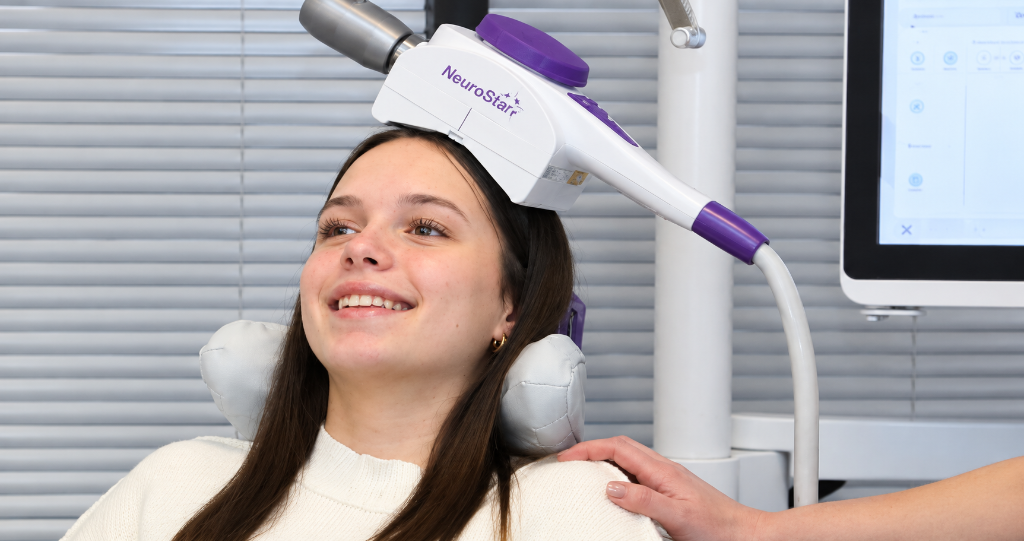
You sit comfortably in an ergonomic treatment chair with earplugs to protect against clicking sounds. Our certified technician positions the patented SenStar® coil against your left forehead.
19-Minute Magnetic Pulse Delivery
Pulses are delivered in brief intervals over approximately 19 minutes. You will feel a light tapping sensation on the scalp. You can chat with our team, read, listen to music, or watch videos.
Immediate Return to Daily Life
Because TMS involves no sedation or cognitive impairment, you can immediately drive home, return to work, or continue your daily schedule without restriction.
Treatment Protocol & When You Feel Results
A standard course of NeuroStar TMS consists of 36 sessions administered over 9 weeks:
- Acute Phase: 1 session per day, 5 days per week for 6 weeks (30 sessions).
- Taper Phase: 6 sessions gradually spaced over the subsequent 3 weeks.
Weeks 1–2: Initial Adaptation
The scalp acclimates to magnetic pulses. Patients often report early improvements in nighttime sleep and physical calm.
Weeks 3–4: "Lifting of the Fog"
Noticeable mood shifts begin. Family members frequently observe greater social engagement, spontaneous smiles, and brighter energy.
Weeks 5–6: Clinical Response
Standard depression assessment scores (PHQ-9) show marked reductions, and cognitive clarity continues to sharpen.
Weeks 7–9: Long-Term Stabilization
During the taper, newly established neural pathways consolidate into lasting emotional resilience.
NeuroStar TMS vs. Oral Antidepressants vs. ECT
Comparing TMS with oral medications and Electroconvulsive Therapy illustrates why so many patients choose non-systemic neuromodulation:
| Feature | NeuroStar® TMS | Antidepressant Meds | ECT Therapy |
|---|---|---|---|
| Method | Pulsed magnetic fields | Daily oral pharmaceuticals | Electrically induced seizure |
| Target Area | Precise (Left DLPFC) | Global (Circulates in body) | Whole-brain stimulation |
| Anesthesia? | No (Awake & alert) | No | Yes (General anesthesia) |
| Weight Gain Risk | Zero | Common | Minimal |
| Sexual Side Effects | Zero | Frequent (30%–70%) | Low |
| Memory Loss | Zero (Cognition improves) | Brain fog risk | Significant amnesia risk |
| Driving Afterward | Drive immediately | Allowed unless sedated | Driver required |
For patients managing treatment-resistant depression, avoiding systemic side effects while receiving proven brain-directed care is a decisive benefit. Review our guide: Common Side Effects of TMS Therapy.
Proven Clinical Benefits & Real-World Outcomes
NeuroStar Advanced Therapy is backed by extensive real-world clinical data. In the NeuroStar Outcomes Registry, which evaluated more than 6,000 real-world depression patients across the United States:
Response Rate
Experienced significant clinical improvement in depressive symptoms.
Remission Rate
Achieved complete remission, returning to non-depressed diagnostic levels.
Sessions Delivered
Demonstrated outstanding long-term tolerability and safety nationwide.
Importantly, 68% of responders maintain their positive clinical outcomes at one-year follow-up, confirming the enduring power of targeted neuroplasticity.
Who Qualifies for NeuroStar TMS Therapy?
NeuroStar TMS is FDA-cleared for multiple psychiatric applications:
- Adult Major Depression: Adults who have not found adequate relief from prior antidepressant trials. Read our TMS for Adults page.
- Adolescent Depression (Ages 15–21): In 2024, the FDA cleared NeuroStar as the first and only TMS therapy for adolescent depression. Learn more on our TMS for Adolescents page and Adolescent Mental Health Services.
- Anxious Depression: Adults suffering from depression co-occurring with persistent anxiety.
- Obsessive-Compulsive Disorder (OCD): Adjunctive treatment for refractory OCD symptoms. Read our detailed analysis: Is OCD a Disability?.
Safety Contraindications
Because TMS relies on strong magnetic fields, candidates must be free of ferromagnetic metals implanted within 30 centimeters (12 inches) of the head coil. Non-candidates include individuals with metallic aneurysm clips, cochlear implants, or deep brain stimulators. Dental fillings, crowns, and orthodontic braces are non-ferromagnetic and 100% safe.
Comprehensive Psychiatric Care & Clinical Support
At Tranquil Minds Mental Health, our team brings doctor-led, compassionate mental health care to patients across Wright County and central Minnesota—including Monticello, Buffalo, Big Lake, Becker, St. Cloud, Albertville, and Otsego.
In addition to NeuroStar TMS, our clinic provides medication management, psychotherapy, and objective Creyos cognitive testing to measure mental clarity throughout recovery.
Most major health plans in Minnesota—including Blue Cross Blue Shield, HealthPartners, UCare, Medica, Optum, and Medicare—cover NeuroStar TMS. Check our insurance guides: How Much Does TMS Cost With Insurance? and Is TMS Covered by Medicare?.
Conclusion: A Proven, Medication-Free Path to Mental Wellness
Clinical depression should not require enduring debilitating medication side effects or feeling disconnected from your life. For individuals who have struggled to find relief through traditional oral antidepressants, NeuroStar TMS offers an evidence-based, biologically targeted medical alternative that reactivates dormant brain pathways directly at their neurological root.
With over 6.1 million successful treatments delivered, an 83% clinical response rate, zero systemic side effects, and zero downtime, NeuroStar TMS therapy allows you to reclaim your cognitive clarity, emotional stability, and daily energy.
If you or someone you care about is ready to explore non-pharmacological depression relief, our team is here to support every step of your healing journey.
Frequently Asked Questions About How NeuroStar TMS Works
Does NeuroStar TMS hurt or cause pain?
No, NeuroStar TMS is not painful for most patients. People typically describe it as a light, rhythmic tapping on the scalp, like a woodpecker or finger tap. Any mild scalp tenderness resolves within the first one to two weeks as your scalp adapts.
How quickly does NeuroStar TMS start working?
Because TMS works through cumulative neuroplasticity, most patients begin seeing meaningful mood improvements between weeks 3 and 4 (sessions 15–20). Early signs often include better sleep, increased morning energy, and easier mental focus.
Can I drive myself to and from my TMS sessions?
Yes, absolutely. Because NeuroStar TMS requires no anesthesia, sedation, or sedating medications, your motor skills and cognitive abilities remain unimpaired. You can drive yourself to our Monticello clinic, complete your session, and return to your day immediately.
Are the results of NeuroStar TMS permanent?
NeuroStar TMS produces enduring neuroplastic improvements. Follow-up research indicates that 68% of responders maintain their clinical relief at 12 months. If mild symptoms return later, a brief maintenance series quickly restores full clinical benefits.
Do I have to stop taking my antidepressant medications during TMS?
No. NeuroStar TMS can be safely combined with your existing psychiatric medications. Once clinical remission is achieved, our psychiatric provider can evaluate whether a careful, supervised taper is suitable for you.
Does NeuroStar TMS cause memory loss or personality changes?
No. Unlike ECT, NeuroStar TMS does not cause seizures or memory loss. Clinical trials confirm that cognitive functions—such as executive concentration, working memory, and mental processing speed—frequently improve as depressive symptoms resolve.
Is NeuroStar TMS safe for adolescents and teenagers?
Yes. In March 2024, the FDA cleared NeuroStar TMS as the first and only TMS therapy for adolescent depression (ages 15 to 21). It offers young adults a safe, drug-free option that avoids antidepressant side effects and black-box warnings.
Is NeuroStar TMS covered by health insurance in Minnesota?
Yes. Most major Minnesota insurance providers—including Blue Cross Blue Shield, HealthPartners, UCare, Medica, Optum, and Medicare—cover NeuroStar TMS for treatment-resistant depression. Tranquil Minds handles all benefit verifications and prior authorizations for you.